
English| EUR
Suggested for you
More currencies
Choose a language
Mehrangarh Fort anchors most Jodhpur blue city walking tours, and visitor feedback clusters around three recurring themes: the fort's scale, the intensity of midday heat, and the value of arriving early. This page synthesizes patterns from recent tour reviews to inform your visit.
Quick answer
Jodhpur blue city tour reviews consistently highlight Mehrangarh Fort as the tour centerpiece, with visitors recommending morning arrivals between 09:00 and 11:00 to avoid afternoon heat and crowds. The 800 INR conservation fee for international visitors is noted as reasonable given the fort's museum galleries and panoramic views over the blue-painted old city. Most feedback emphasizes that walking the ramparts and exploring the palace courtyards requires two to three hours.
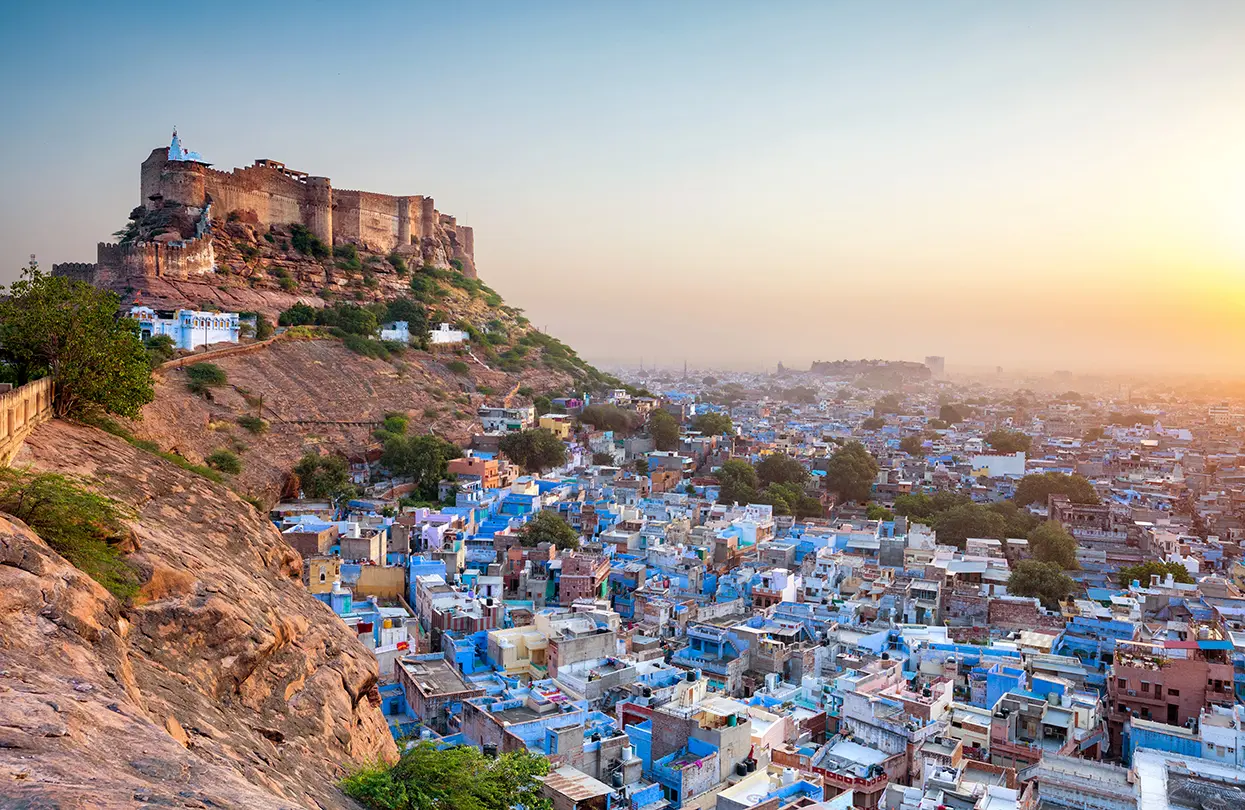
Mehrangarh Fort rises 122 meters above Jodhpur on a perpendicular cliff, and every guided walking tour of the blue city either begins or culminates at its gates. Built in 1459 by Rao Jodha, the fort's red sandstone walls enclose seven gates, multiple palaces, and a museum collection spanning five centuries of Rajput history. Visitor feedback from 2025 and 2026 reveals a consistent pattern: the fort's architecture and collection exceed expectations, but the physical demands of the site—steep ramps, sun-exposed courtyards, and sustained walking—require preparation. Jodhpur blue city tour reviews frequently cite the view from the fort's ramparts as the defining visual moment of the experience. From the top, the old city's indigo-washed houses spread across the plain in a dense, geometric grid. Photography conditions peak in morning light, when shadows define the blue facades and the glare softens. Afternoon visits, particularly between May and September, bring intense heat that limits comfortable exploration time. Visitors in recent months have noted that the fort's courtyards offer limited shade, making hydration and sun protection non-negotiable. The fort's museum galleries—Moti Mahal, Phool Mahal, Sheesh Mahal—contain miniature paintings, royal palanquins, arms, and textiles, all labeled in English and Hindi. Feedback on guided tours versus self-guided visits splits evenly: those who hired guides at the entrance appreciated context on Rajput royal lineage and architectural symbolism, while independent visitors valued the freedom to pace their visit. The audio guide, available for an additional fee, receives consistent praise for depth. Practical patterns emerge across reviews. Visitors arriving before 10:00 report manageable crowds and access to popular photo vantage points without queuing. Those arriving after noon describe congestion at narrow passages and wait times at gallery entrances. The walk from the blue city's Navchokiya neighborhood to the fort's Jai Pol gate takes 15 to 20 minutes uphill; many tours include vehicle transport to the top, a detail worth confirming when booking. The conservation fee supports ongoing restoration, a fact visitors note positively when comparing Mehrangarh to other Indian heritage sites.
“From the ramparts, the indigo geometry of the old city unfolds in a grid that photography never quite captures—you need the elevation to understand the blue city's actual density.”
Mehrangarh Fort is an active heritage site with specific conduct expectations. Respectful behavior preserves the experience for all visitors and protects the monument's integrity.
Everything you need to know about jodhpur blue city tour reviews